Ceramic mug
Soft clay becomes a rigid, partly glassy body.
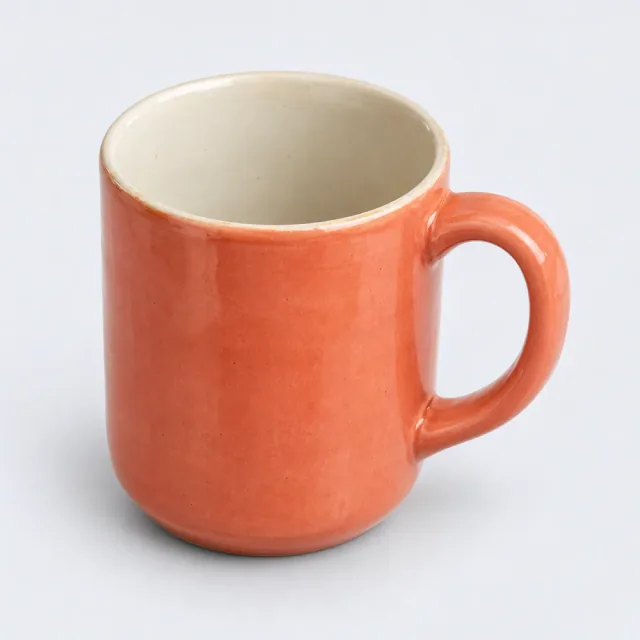
A porcelain mug starts as a shaped mixture of mineral ingredients, then changes during firing. The finished body is not simply dried clay: heat creates a dense ceramic structure containing crystalline and glassy phases. A glaze gives the surface a smooth finish. The body, handle and foot have different functions even when made from the same porcelain. This example shows a glazed porcelain mug rather than every type of drinking vessel.
Start with a part, then follow a material. No specialist knowledge needed.
Inside the object
Original conceptual illustration. Numbers open the component index; their positions are illustrative, not a disassembly guide. Equivalent text follows beside the diagram.
1Cup body
The curved wall holds liquid and withstands handling. Its ceramic body is stiff and resists ordinary hot-drink conditions, but it does not yield like a metal when dropped. Thickness, firing quality and small defects help determine whether a knock produces a harmless sound or a growing crack.
2Glaze
A fired glaze is a thin glassy ceramic coating formulated from several mineral ingredients. Silica and alumina are constituents of that formulation, not loose grains sprinkled onto the finished mug. Glaze chemistry must be compatible with the body so that cooling stresses do not cause persistent cracking or flaking.
3Handle
The handle provides a gripping point away from the hot wall and is often formed separately before being joined to the body. Its curved shape and attachment points carry the filled mug’s weight. Even though its material matches the cup, its geometry creates different local stresses.
4Foot ring
A raised foot gives the mug a stable contact with a table and may be left unglazed where it meets kiln furniture during firing. This small region is part of the porcelain body. Roughness here affects surfaces it touches, and chips can create sharp edges.
Why these materials?
Firing explains both porcelain’s usefulness and its limitations. Mineral particles react and consolidate into a hard body that keeps its shape when wet. The glaze supplies a smooth surface that is easier to clean than an unfinished porous body. But a hard ceramic has little capacity for plastic deformation: an impact can extend an existing flaw instead of leaving a dent. Temperature changes also produce expansion and stress. A mug is consequently a designed pairing of body and glaze, not a clay cup covered in interchangeable decorative paint.
One object, many versions.
Stoneware and earthenware use different bodies and firing conditions; some rely more heavily on glaze to limit water absorption. Glass mugs, enamelled metal cups and insulated stainless vessels follow different material strategies. Microwave or dishwasher suitability depends on the specific finished article, including decorations and damage. Porcelain as a material name is not a universal appliance-use permission.
What happens after use?
An intact mug can be reused or passed on. A chipped or cracked drinking surface deserves caution, and decorative repair does not automatically restore suitability for hot food or drink. Ceramic mugs generally do not belong in bottle-glass recycling because they behave differently in glass furnaces. Check local residual or construction-waste guidance for broken ceramics and contain sharp pieces safely.
Familiar things, connected.


Follow the evidence
Original explanations informed by the sources below. Technical and industry sources support material behaviour; industry environmental marketing is not treated as a universal comparison. Read our editorial method.
- OFANTLIGT mug: materials and care ↗IKEA · Undated · Checked 2026-11-13
- About glass ↗British Glass · Undated · Checked 2026-11-13
- Borosilicate glass ↗SCHOTT · Undated · Checked 2026-11-13
- Holistic health: How ceramics and glass contribute to our physical and mental wellbeing ↗The American Ceramic Society · Undated · Checked 2026-11-13
- Rivalry and Dresden plates and quilts: European porcelain production ↗The American Ceramic Society · Undated · Checked 2026-11-13
- Quality of recycling: Towards a reference framework for the circular economy ↗European Commission Joint Research Centre · 2020 · Checked 2026-11-13
- Silica ↗Sibelco · Undated · Checked 2026-11-13
- Silica is safe — frequently asked questions ↗Evonik · Undated · Checked 2026-11-13
- Silica dust ↗UK Health and Safety Executive · Undated · Checked 2026-11-13
- Advanced Ceramic Substrates for Electronic Applications ↗CeramTec · Undated · Checked 2026-11-13
- Aluminum Production and Processing ↗The Aluminum Association · Undated · Checked 2026-11-13